FinanceKey just made real treasury AI possible
FinanceKey’s native Model Context Protocol server gives finance teams, and their AI tools, direct, live access to the beating heart of corporate liquidity. This is not an upgrade. It is a category shift.
By Macer Skeels, CTO and Co-Founder, FinanceKey
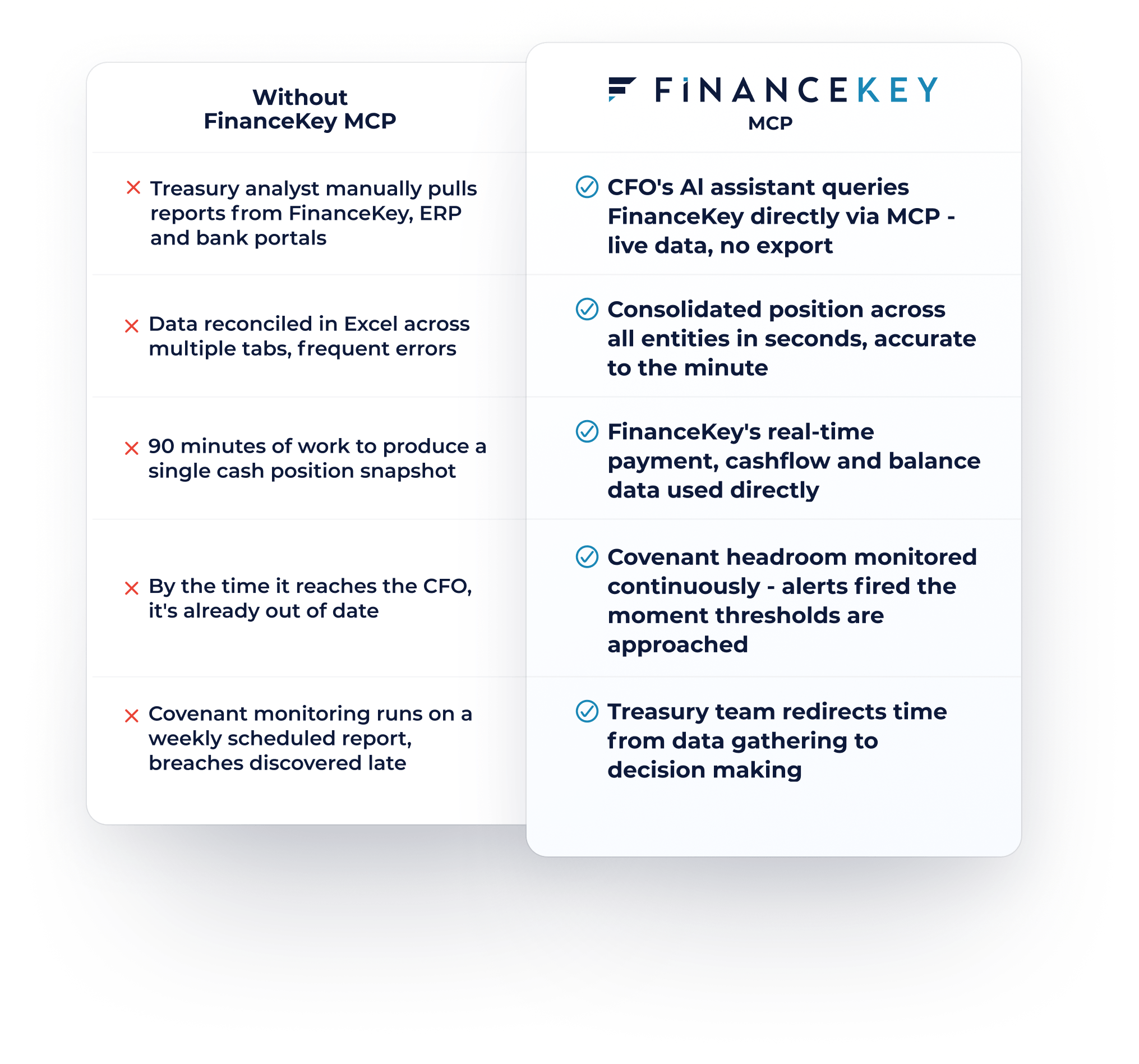
It is Monday morning. Your CFO has a board call in two hours and wants a consolidated global cash position… across all 14 entities, net of last week’s FX movements, with a view on intraday liquidity utilisation. Your team has 90 minutes to pull reports from three systems, reconcile the numbers in a spreadsheet, sense-check the intercompany positions, and format it for the room. Assume nothing has broken over the weekend.
This is not a failure of your team. It is a failure of architecture. The systems that hold your most critical data were never designed to be talked to. They were designed to be queried, exported and reconciled. Getting a real answer has always required a report, a spreadsheet and, more often than not, a phone call.
FinanceKey changes this. Not by adding another dashboard. Not by embedding a chatbot that summarises yesterday’s data. But by opening a live, secure, structured connection between your treasury operations and any AI tool your organisation chooses to use. The CFO’s question, asked directly to an AI assistant, is answered in seconds, sourced from FinanceKey’s live data, accurate to the current moment.
FinanceKey was already ahead on real-time
Before examining what the MCP connection unlocks, it is worth being direct about what FinanceKey already does that most treasury platforms do not: it operates on real-time data rails.
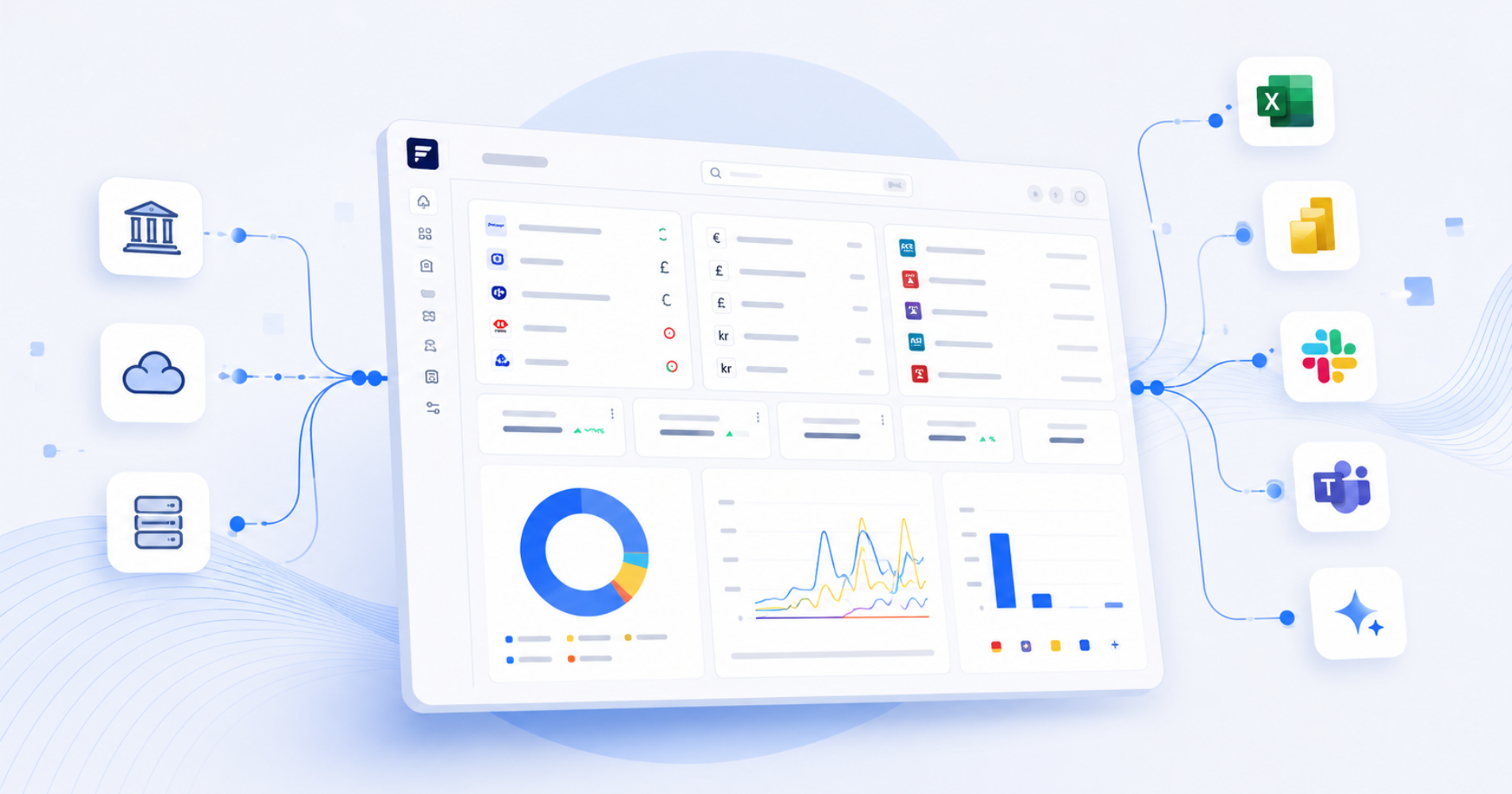
Most TMS platforms operate on overnight batch processes. Your 9 a.m. cash position report reflects balances as of the prior evening’s bank statement. Decisions made on that data are decisions made in the past. FinanceKey is different. Payment instructions, booking cycles, cashflow items and account balances update as activity occurs. FX positions reflect the present moment, not yesterday’s close. Intercompany lending calculations draw on actual current figures.
This matters because AI is only as useful as the data it can reach. A powerful AI model working from last night’s export is not a treasury tool. It is a sophisticated summariser of stale information. FinanceKey’s real-time foundation is what makes the AI connection genuinely valuable rather than merely impressive on a slide.
What is an MCP server, and why does it matter here?
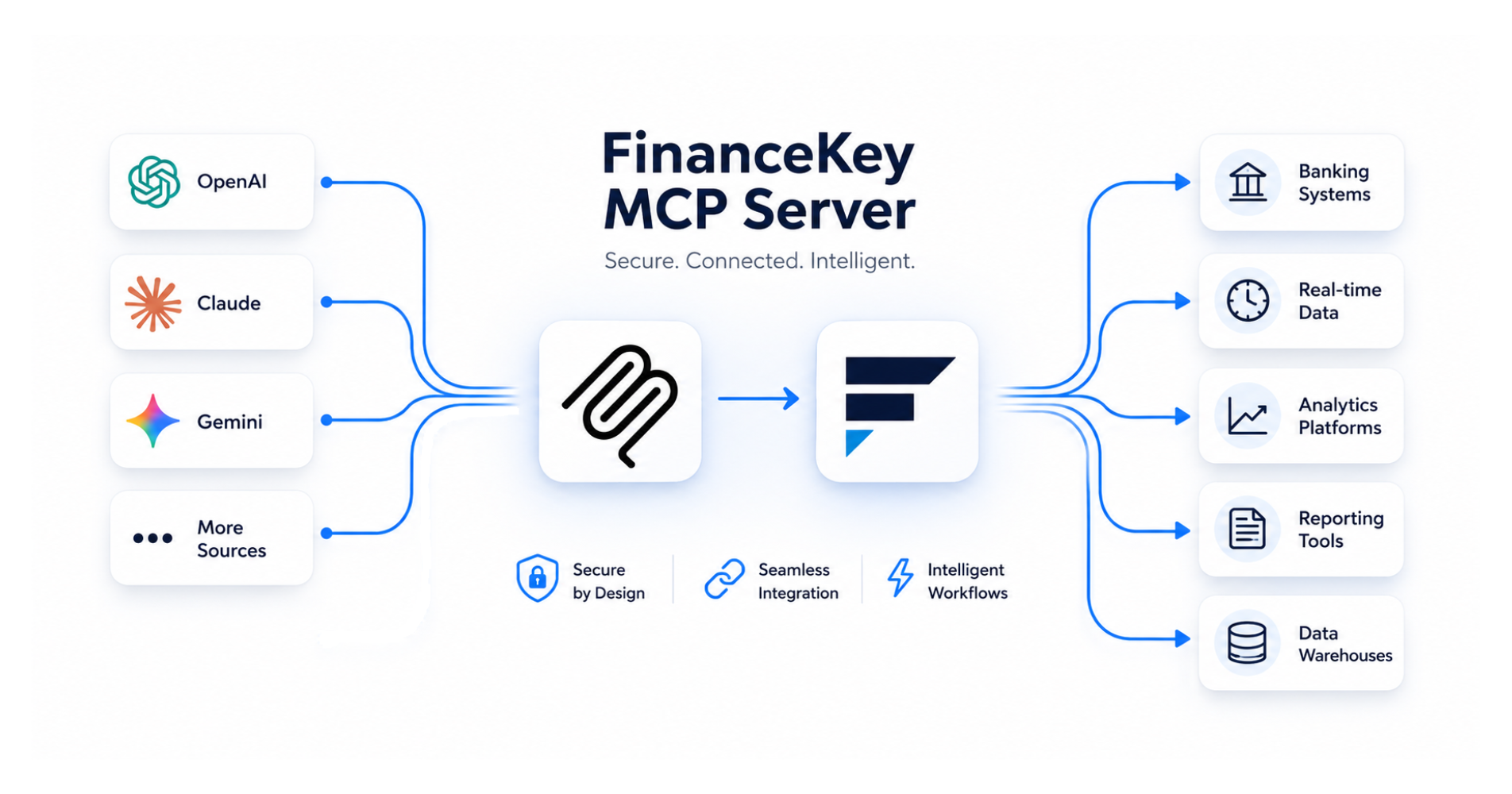
The Model Context Protocol, developed by Anthropic and now adopted across the AI industry as an open standard, is best understood as a universal connector: a structured way for AI models to reach into external systems and interact with real data, real tools and real workflows.
An MCP server exposes a system’s capabilities, its data, its functions, its actions, in a format that any compliant AI model can use. Claude, GPT-4, Gemini and others can all connect to FinanceKey’s MCP server and immediately begin using the tools it provides. No custom integration. No one-off API wrapper. No negotiation between engineering teams. Just connection, capability and execution.
For treasury, this means something profound: your organisation’s AI assistant, whichever model you prefer and however you choose to deploy it, can now have direct, structured, live access to your treasury operations. It can check today’s cash position. It can model a funding gap. It can surface a breached covenant. It can draft a board memo grounded in data accurate to this minute. And it does all of this not by guessing, not by recalling training data, but by reaching into a live system and reading the truth.
Examples of what your AI can now do with FinanceKey’s MCP:
- Ask for a consolidated cash position across all entities… accurate to the minute
- Surface payments awaiting approval, with full booking cycle and instruction detail
- Monitor covenant headroom continuously and alert when thresholds are approached
- Pull intraday liquidity utilisation and draft board-ready summaries from live data
- Analyse FX exposure across your real-time positions… not last night’s close
- Review intercompany lending opportunities against actual current account balances
- Query cashflow forecasts and identify funding gaps before they become problems
- Retrieve statement transactions and reconciliation status on demand.
FinanceKey went further than an AI agent
Many treasury platforms have introduced “AI features” in the past two years: embedded chatbots, automated report summaries, alert assistants built into the platform interface. These are useful additions. FinanceKey has them too.
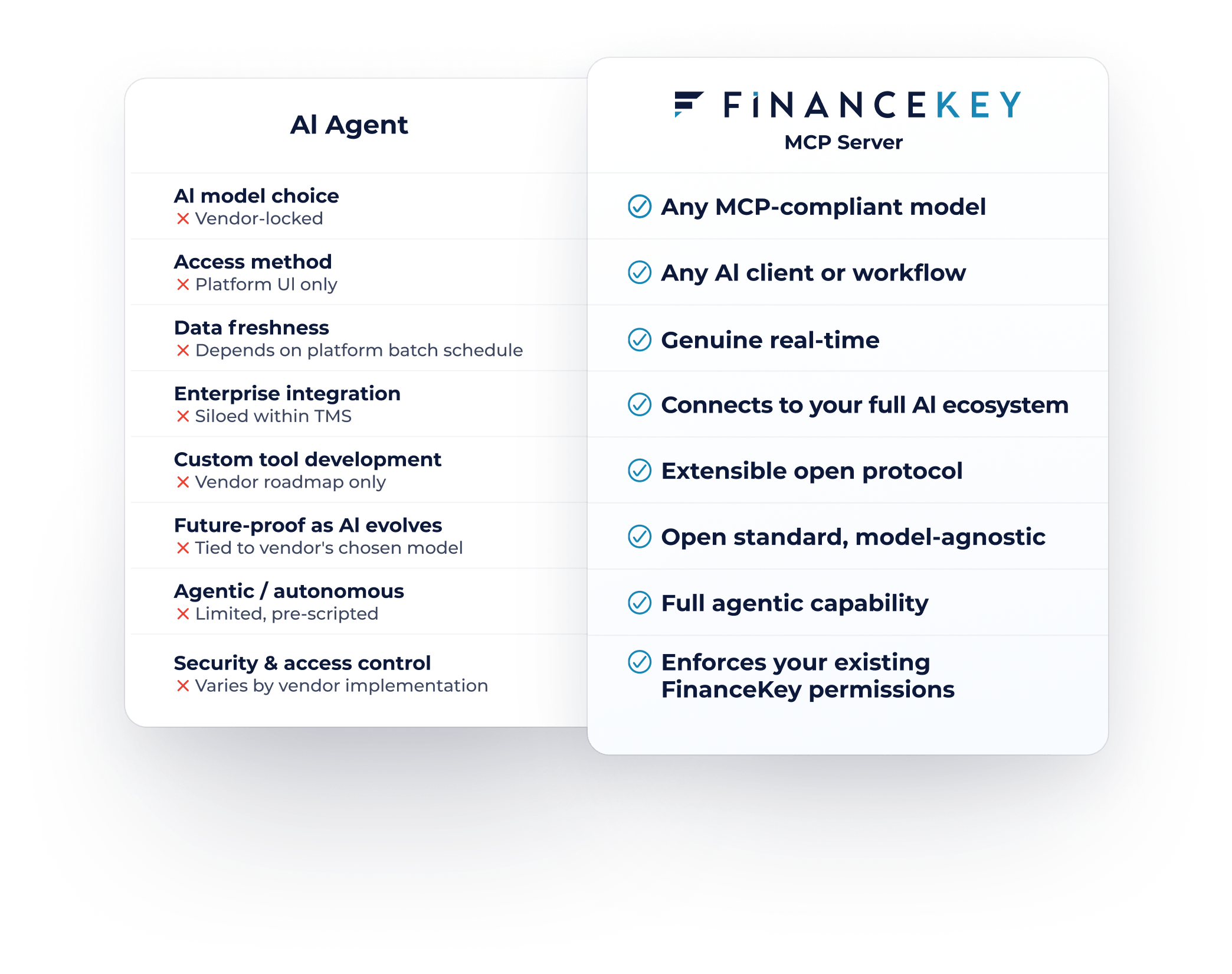
But FinanceKey also recognised that embedding a single AI model inside a platform is the wrong architectural choice for organisations that take their AI strategy seriously. An embedded agent is a fixed feature: one model, chosen by the vendor, accessible only through the vendor’s interface, doing only what the vendor has programmed it to do. When your organisation’s AI standards evolve, and they will, you are stuck.
The MCP server is a different proposition entirely. It makes FinanceKey’s treasury capabilities available as a set of structured tools that any AI can call. Your enterprise AI assistant, your autonomous finance agent, your custom-built workflow model can all connect to FinanceKey and use its live data. The intelligence is yours to choose. The data is live. The connection is open.
Open to AI does not mean open to everyone
The natural question from any treasurer, compliance officer or information security team is: if AI models can connect directly to FinanceKey, who controls what they can see?
The answer is straightforward: FinanceKey’s MCP server does not bypass your security model. It enforces it. Every request made through the MCP server is authenticated against the identity of the user or system making the call. The server knows who is asking. It applies FinanceKey’s existing permission model, role-based access controls, entity-level restrictions, user-specific permissions, to each and every response it returns.
A user who cannot see a particular entity’s balances in FinanceKey will not receive those balances through an AI query. A user with read-only access to certain accounts will find that boundary holds when an AI is working on their behalf. No access means no data. Limited access means limited data. The full security and governance framework you have configured inside FinanceKey travels with every AI interaction.
The audit trail remains intact. AI can ask questions it is authorised to ask. It cannot ask questions it is not. For information security teams evaluating AI adoption in treasury, this is not a leap into the unknown. It is the same access model you already trust, extended to a new interface.
AI surfaces. Humans decide.
A concern we hear often from treasury teams is: what if the AI gets it wrong? It is a fair question. Treasury errors carry real consequences.
Today, FinanceKey’s MCP server operates as a read and query layer. AI can retrieve data, surface analysis, draft documents and flag issues. It does not execute payments, approve booking cycles or submit transaction files. Nothing is written to FinanceKey without a human making that call. The decisions that matter remain with your team. What changes is the quality and speed of the information available when those decisions are made.
Think of it as upgrading the analyst sitting beside the treasurer. The analyst can pull any figure from FinanceKey instantly, run comparisons, draft the memo and surface the covenant breach before it becomes a crisis. The treasurer still signs off. The audit committee still reviews. The controls are unchanged. The capability is transformed.
That said, read-only is not where this ends. The direction of travel is toward AI that can act as well as advise: preparing a payment file for upload, initiating a booking cycle, submitting transaction data on instruction. FinanceKey’s intention is to extend the MCP server in that direction over time. But the design principle will not change: every action that touches real money or real positions will pass through FinanceKey’s existing approval workflows and human control points.
AI will be able to propose and prepare. It will not be able to execute without authorisation. The governance framework that treasury teams and their audit committees rely on will remain intact, regardless of how capable the AI layer becomes.
This is not a new implementation
One of the most important practical points about FinanceKey’s MCP server is what it is not: it is not a new integration project. It is not a second implementation sitting alongside your existing setup. It connects to the FinanceKey instance you already run, using the data you already have, respecting the permissions you have already configured.
For organisations already using FinanceKey, the path to AI-connected treasury is shorter than most would expect. The infrastructure is there. The real-time data is there. The security model is there. Connecting an AI tool to FinanceKey via MCP is an addition, not a transformation of what you already have.
The treasury stack just changed
Enterprise AI is maturing rapidly. The organisations that will lead in treasury over the next decade are not the ones with the most powerful AI models. They are the ones whose systems can actually feed those models accurate, live, structured data.
FinanceKey is now that system for treasury. Real-time data. An open, standards-based AI connection. Your security model, enforced. Your choice of AI, respected. Your team’s judgment, where it belongs.
For treasury teams evaluating where AI fits in their operations, the question is no longer whether AI can help. It is whether your treasury platform can be trusted to give AI the truth. FinanceKey can.
Get in touch to see FinanceKey’s MCP server in action.