The TMS gap: Why treasury still runs in spreadsheets
By Veikko Koski, Co-Founder, FinanceKey
You have a TMS. You went through the implementation. You paid the fees, absorbed the disruption, and got the team trained. On paper, treasury is covered.
So why does Monday still start with four hours of manual work?
Most treasury teams we speak with would say they have a solution in place. And they’re right – up to a point. The TMS is running. It’s capturing FX deals, reconciling positions, producing reports. It’s doing exactly what it was designed to do.
The problem is what it wasn’t designed to do.
Here are some things I’ve heard recently when talking to treasurers. See if any of them sound familiar:
- Monday morning spent updating the cash forecast manually before the first meeting – chasing updates from regional controllers, copy-pasting, fixing number formats.
- Urgent tax and customs payments surfacing mid-week with no advance warning.
- Overdraft interest charged on a USD 10M shortfall because vendor payment visibility from the ERP simply wasn’t there.
- Friday afternoon: reconciling AT bookings with the back office, then consolidating liquidity figures into a spreadsheet – outside the TMS – to send by email to management and the C-suite.
Most teams don’t flag these as system problems.
Time, money, and organisational energy went into getting the current setup running – some still have nightmares about implementation projects that ran far longer than expected, where configuring the right reports cost another six figures in fees.
Once you’ve been through that, the instinct is to build workarounds rather than risk starting again.
But at what cost?
From systems of record to systems of action
All the above scenarios happen because of what we call the TMS gap.
It’s often explained as a delivery problem – modules not implemented, integrations postponed, a phase two that never came. And that’s part of it. But even when those phases do happen, something more fundamental remains.
TMS were built as systems of record. They capture FX deals, money market investments, and derivative instruments. They calculate valuations and prepare treasury accounting. Their role is to ensure positions are recorded, reconciled, and reported – accurately, and after the fact.
Modern treasury needs more: systems that don’t just store data, but interpret it, connect it, and act on it in real time. Systems that are excellent at:
- Recording positions
- Enforcing controls and auditability
- Standardising processes
- Producing reports
But also able to:
- See cash positions intraday, not after the fact
- Orchestrate liquidity across banks, entities, regions and countries
- Anticipate movements, not just reconcile them
- Control and optimise payments before they happen
Storing data is not enough. Treasury today needs systems of intelligence and real-time orchestration.
What the gap is really costing you
Not in abstract efficiency terms. In real ones.
Cash is sitting in accounts you can’t see – across banks, entities, and countries, earning nothing and doing nothing. Because the visibility isn’t there at the right moment, it doesn’t get swept, pooled, or put to work.
Extra cash buffers are held “just in case” – tying up capital unnecessarily.
Without an accurate intraday position, you draw on credit facilities you didn’t need to touch. We’ve seen it happen: an entity submitting a borrowing request when their own cash balance – accounting for expected inflows and outflows – was sufficient. The problem wasn’t the cash. It was the visibility.
A $2 million buffer held by a group entity carries a $130k cost at group level when the shortfall is funded from a credit facility.
FX works the same way. When entities make foreign currency payments locally without treasury oversight, the spread the bank charges accumulates. That cost doesn’t appear anywhere obvious. It just happens, repeatedly.
$10 million in unmanaged FX transfers can easily cost $100k in unnecessary spread.
And every hour spent logging into e-banking portals, copy-pasting data, and rebuilding spreadsheets is an hour not spent on decisions that actually move the needle.
The pattern is consistent: limited visibility leads to value leakage – and systems built around end-of-day reporting don’t give treasury the chance to prevent it.
Identifying the gaps in legacy TMS
Here are the typical limitations that show up in treasury systems that have been in place for decades. They span three layers – data, decision, and execution.
| Layer | Gap | What’s missing |
| Data layer | Real-time visibility | Cash positions are batch-based, often based on end-of-day reporting. Intraday visibility is limited or missing, meaning treasury works with outdated information. |
| Connectivity | Bank and ERP integrations are slow to build and maintain. API support is limited, and adding new banks or entities remains a project. Issue resolution is time-consuming and resource-intensive. | |
| Data quality | Data is fragmented and inconsistent across systems. Reconciliation and validation are manual, reducing trust in the data. | |
| Decision layer | Forecasting | Forecasts are static and manually maintained. Systems lack flexibility and do not leverage live or historical data to generate dynamic forecasts. |
| Intelligence | Systems report what happened but provide limited insight into what matters or what to do next. AI-driven recommendations and automation are largely missing. | |
| Execution layer | Orchestration | Cash and liquidity decisions are not coordinated across the organisation. Systems record activity but do not direct or optimise it. |
| Collaboration | Treasury, finance, and subsidiaries operate in silos. Communication and approvals happen outside the system, limiting shared visibility. | |
| Usability | Interfaces are complex. Core workflows require multiple steps. Teams fall back on spreadsheets to get work done. Limited support for intuitive, real-time dashboards for treasury leadership and the C-level. |
Closing the gap – without starting over
The pressure isn’t going away. Treasury teams are being asked to do more with less – faster decisions, greater visibility, tighter control. AI will play a role in this shift, not as a replacement but as an enabler: a layer of intelligence that surfaces actions, supports decision-making, and frees up time for higher-value work.
This isn’t another system project. The investment in your TMS isn’t wasted – the gap isn’t what you have, it’s what’s missing around it.
The opportunity is to introduce what was never there: real-time intelligence and orchestration that works alongside your existing setup.
What this looks like in practice
This is what we built FinanceKey to do.
You decide how your system landscape should look – we adapt to it.
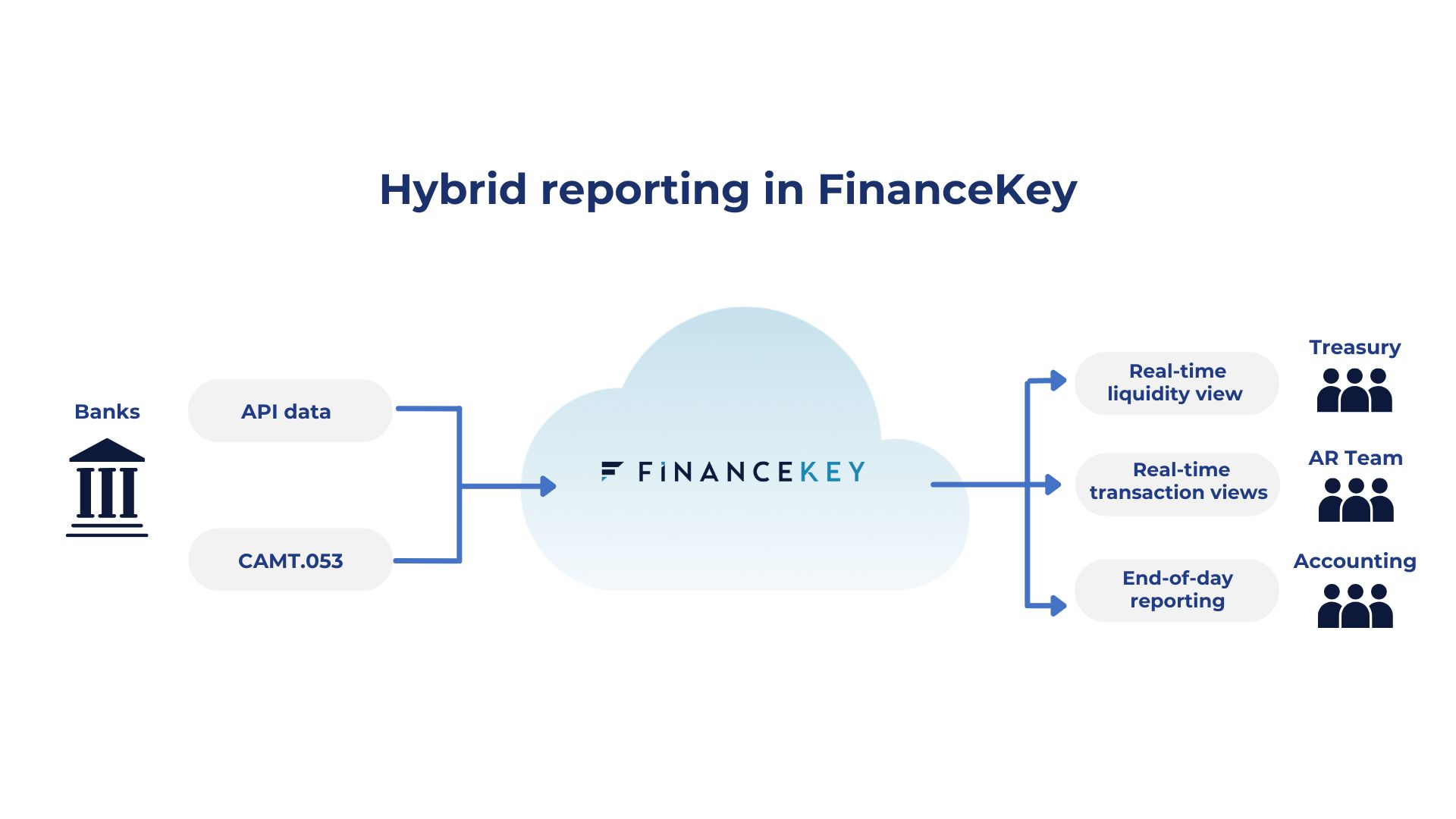
For some teams, this means connecting directly to banks and ERP systems and using FinanceKey as a full operating layer for payments, cash flows, and connectivity.
For others, it means complementing an existing TMS – filling specific gaps in visibility, forecasting, payments, and bank connectivity without replacing what already works.
Most teams start seeing impact within days – not months – without heavy implementation or IT involvement.
The outcome is consistent:
- Intraday cash positions built automatically from live data
- Excess liquidity identified and centralised
- Forecasts continuously updated, not manually rebuilt
- Full visibility, monitoring and control over payments
- Credit facilities used only when truly needed
Not by adding more process – but by removing the need for it.
The question that matters now
Systems of record defined the past of treasury. Systems of intelligence and real-time orchestration will define what comes next.
The treasurers who adapt won’t just save time – they’ll unlock cash, reduce risk, and redefine their role in the business.
The question isn’t whether your TMS has gaps. It’s how much those gaps are costing you right now – and whether you have visibility into that number.
Download the hidden cash playbook below to see real-world examples of companies that have closed the TMS gap and seen rapid RoI.
Unlocking hidden cash:
the playbook
Most finance teams are sitting on idle cash they don’t know about. This playbook shows you how to find it, move it, and put it to work – without hiring anyone new.